Walk into any toy store and you'll see "STEM" slapped on everything from building blocks to bath toys. The label has become so common it's almost meaningless. But behind the marketing, there's real substance: the right STEM kit can genuinely change how a child thinks about the world. The question is how to separate the kits that teach from the kits that just look educational.
What Makes a STEM Kit Actually Work
After years of curating our STEM & Learning collection, we've noticed patterns in what makes a kit effective versus what makes it shelf candy. The good ones share three traits:
1. Real components, not props
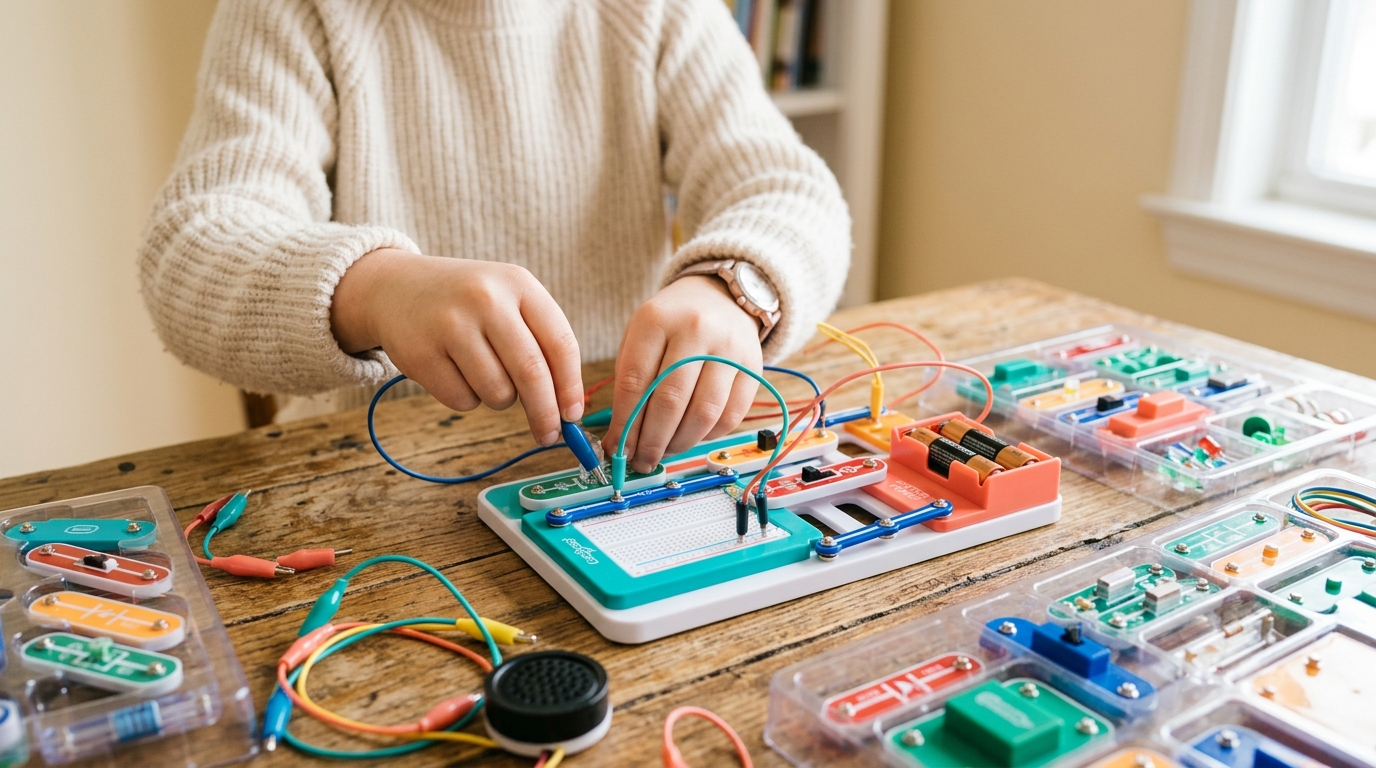
A kit that includes actual wires, batteries, and switches teaches more than one with plastic look-alikes. When a child connects a real circuit and an LED lights up, that moment of "I made this work" is irreplaceable. Our 45-piece circuit building kit uses genuine electrical components scaled for small hands.
2. Open-ended building, not single-outcome projects
Kits that only build one thing teach kids to follow instructions, which is valuable. But kits that let kids build multiple projects — or invent their own — teach them to think creatively. The hydraulic robotics arm kit can be assembled in several configurations, and its Arduino compatibility means older kids can program it.
3. Failure is part of the process
The best STEM kits don't work perfectly the first time. A circuit that doesn't light up because a connection is loose teaches problem-solving. A robot arm that doesn't move because a syringe is misaligned teaches debugging. These small failures build resilience — the same skill engineers use every day.
The STEM Kits We Actually Recommend
Not every kit in our catalog is right for every child, but these four consistently get the best feedback from parents:
For beginners (ages 6-8): Circuit Building Kit
The 45-piece circuit kit is the most accessible entry point. No soldering, no screens — just snap-together components that teach series and parallel circuits, switches, and conductivity. Kids can build a working fan, a light system, and a sound machine in their first session.
For tinkerers (ages 8-10): Hydraulic Robotics Arm
The hydraulic robotics arm uses water-filled syringes as hydraulic pistons — a clever mechanical concept that's visible and tangible. Kids learn about fluid dynamics, levers, and rotational motion while building something that actually picks up objects.
For explorers (ages 7-10): Microscope Kit
The compact microscope kit isn't the most powerful microscope on the market, but it's the right one for kids. It's durable, easy to focus, and turns everyday objects — leaves, fabric, salt crystals — into wonders. Pair it with the science experiment kit for guided investigations.
For future programmers (ages 7-11): Coding Robot
The coding robot teaches programming logic through physical interaction. Kids "program" the robot by pressing buttons in sequence, then watch it execute their commands. It's screen-free coding that builds the mental models needed for text-based programming later.
How to Support STEM Play at Home
The kit is just the starting point. Here's how to make STEM play stick:
- Ask open questions. Instead of "Did it work?" try "What happened when you connected those two pieces?"
- Don't fix it for them. When something doesn't work, guide them through troubleshooting rather than solving it yourself.
- Connect it to real life. Point out that the circuit kit uses the same principles as the lights in your house. The hydraulic arm works like the brakes in a car.
- Give it time. STEM play often requires 30-60 minutes of focused attention. Protect that time from interruptions.
Looking for more STEM inspiration? Browse our full STEM & Learning collection or reach out for personalized recommendations.